Showing posts with label dying languages. Show all posts

Monday, October 13, 2008

What is the Filipino Language?

What is the Filipino language? Well, Virginia there's no such thing as the Filipino language. It doesn't exist or it exists only on a political toilet paper called the Constitution. There are only Filipino languages namely, Hiligaynon, Bisaya, Ilokano, and Waray etc. Filipino language is actually Tagalog in disguise like the Trojan malware in your computer pretending to be a legitimate process but is destroying your machine. No, I'm not being harsh. It is the reality.

In schools, we are taught that Filipino is supposed to be Tagalog + Borrowed words from English & others + Regional languages. In reality the equation is Filipino = Tagalog. English add words are slowly being replaced and "translated" even like the word press conference in evening news a Tagalog equivalent is used. Is that proof enough? Let us not even get into grammar, syntax and what not. Why do Tagalog books in schools insist on the amusing word "kompyuter" instead of "computer" is beyond me. It is okay if only 100% of Filipinos are really native Tagalog but we are not. The Filipino language charade has been going on for so long when we all know it is Tagalog. Stop that! This charade has led some speakers to believe they are superior to others (they say Filipino is based on Tagalog - YEAH RIGHT - tell that to the Marines).

My biggest beef with "Filipino language" is this fictional language slowly creates a feeling of superiority to some people as if they are the be-all and end-all of being a Filipino. A Filipino should be some Barong Tagalog wearing guy that speaks like Balagtas (with a fig behind his ear hopefully) and those who don't speak with the right accent are ostracized and ridiculed on radio. Who give you the right to lord over us? Nothing... you are not the boss of us. An Igorot on Bahag is as Filipino as a Malong wearing person in Mindanao. You are never the standard of being a Filipino stop being one!

Why the resentment? Non-Tagalog people are NOT allowed to sing the National Anthem in their native tongue. We have been in this Island long before there was a republic. In addition, we are not ALLOWED TO STUDY OUR OWN LANGUAGE IN OUR SCHOOLS. Why doesn't the government allow us? IT IS OUR RIGHT TO DO SO GIVE IT TO US!!! Unlike Filipino, our Language is REAL.

Some Tagalista professor said it is our fault that our dialect is dying (notice the tone). HAHA! He is a comedian. Give Hiligaynon the necessary funding and I can tell you our language will thrive. In fact our language is thriving despite no government help. Can you say that honestly to that fiction Filipino language? Don't kid yourself.

Thankfully, many non-Tagalog Filipinos are waking up to this reality and are fighting back. There is a Kapampangan cultural renaissance happening led by confident Kapampangan youth who are proud of their way of life. Other short-sighted initiatives were held back - English is still the medium of instruction in schools. Even the National Anthem law is being challenged - local Cebuano legislators are leading the defiance. We realize only we can save our culture.

You may say, so what's the problem?

It is not enough. Only when regional languages are given the RESPECT & recognition they deserve. It means other Non-Tagalog languages should be intellectualized and taught in schools just like in other CIVILIZED NATIONS with RESPECT for DIVERSITY. There are more demands but survival is the top priority right now.

(To be continued)

Wednesday, September 24, 2008

WARAY POETRY: FIGHTING BACK!!!


Waray Music Video - pride is still present among Waray youth. Hurray!

Despite the national policy of suppression of non-Tagalog Philippine languages (Verbal and expressed note of purported support is not enough but real monetary help plus serious effort of intellectualizing other non-Tagalog languages. We can always say I support this or that), it is good to note there are proud people willing to stand up and help their tongue survive and thrive.


A book of Waray poems, Inintokan, by Victor N. Sugbo was launched last Friday under the auspices of the University of the Philippines Tacloban College. It was published by the UP Press as one of its centennial books. Professor Sugbo is a PhD (Communication) from UP Diliman and teaches with the UPTC.

According to the author the root word of the title, intok, means "to knock against or into something," and this is the process through which he wrote the poems: be "hit by something — a thought, a memory, a wave of feeling — that takes a small chip out of our humanity, and changes us." His honesty is arresting: "The poems... were never easy to write because I had always been uncomfortable writing in my mother tongue. My knowledge of Waray was limited to what I used in everyday conversation... My university education taught me to think, speak, and write in English, a matter that later became a way of viewing things.

"Today when I write in Waray, I still grope for the appropriate, if not precise, words. Each poem’s unfolding becomes always an invocation of the many rivers of words I shared with Inday Damiana, my father, my mother, Mano Busio, Mana Maria, Mano Mundo, Mano Poren, neighbors, and people I had met... In the end, one is left with his own well of memory and lexicon."

This is the struggle of any poet writing in neo-colonial times, especially of one highly schooled in English — of course, because he is the product of a long, oppressive and repressive history of colonization. But there is the well of memory and lexicon, the seldom tapped mine that each of us carries deep in us like a chalice. The author’s tone is conversational. And he speaks of the immensely local, the world of the everyday in which he is rooted, like the title of the volume.

Source

Just how important is this very act of coming up with a "minor language" poetry?

every verse line written neither in English nor in Tagalog is an assertion of our pre-colonial state; a valiant act of claiming our right to our own past that was interrupted by the intrusion of the western colonials; an assertion that yes, indeed, our poetic souls prevailed as all our languages triumphed over the horrendous abuses of the Spaniards and the Americans and Manila.

Long live the language resistance movement!


Wednesday, July 30, 2008

RAIN IN RAINING ENGLISH!!!


chicken breast and vegetables

Don't understand the question? Use the translator! Don't be arrogant.
Now you look like a freakin' fool. Learn to be humble, man!


the you-know man

It took Yao Ming two years to finally get rid of his translator in the NBA, to think he studied English in school. He waited two years before he thought he was confident enough to speak in English to the press (though he speaks the language with his teammates before).

At least, Rain is in the right direction. Some "learned" people in my country want the reverse - TAGALIZE everything because their concept of nationalism is skewed and shallow. Their basis of nationalism is your language - even the national hero wrote his greatest works in a foreign one - so what does that make him?

I have an English word for them "BACKWARD". Spare us. A Filipino is not a Barong Tagalog wearing guy that speaks like Balagtas, he is also a proud Moro prince with Kris on his side. Stop putting us in a little box - &^%%!

Tuesday, July 29, 2008

FIRST KAPAMPANGANOVELA

the cast

There are so many stories in our country - the only problem with these "creative" people in the country are they looking outside instead of inside, for they look down on Non-Tagalog speaking people preferring to present a second rate version of other country's works. But we don't care. IF they don't, then other more capable people would...like these Kapampangan youth. Hurray for the KAPAMPANGAN YOUTH!!

To the knowledge of most Filipinos, only Manila has the capability of producing teleseryes in the country, while all other dramas must have been produced by Koreans, Americans, Japanese, Mexicans, or Chinese.

But did you know that in other regions, Pinoy TV dramas are also being produced and are even employing the use of non-Tagalog languages like Cebuano? With the cultural fervor sweeping the regions, one could only be reminded that the Philippines—amidst the institutionalized belief that this archipelago only speaks Tagalog as its language while the rest are mere “dialects”—is, indeed, a diverse country, and that its diversity is bound to extend even to the field of TV dramas.

Take for example the Kapampangans, the latest Filipino ethnolinguistic group to enter the field of teleserye production. This August, which is considered the Language Month, a Kapampangan cable channel (Infomax-8) and a creative pool of Kapampangan youth (Kalalangan Kamaru) will be launching Kálam, the first ever Kapampanganovela—the term introduced to refer to kabalen-produced TV dramas—in Philippine broadcasting history.

source

It is the Kapampangan youth spearheading this renewed cultural fervor. I'm jealous at them (the Ilonggo youth are hibernating at the moment). They are so motivated, creative and proud of their heritage. I wish them Good Luck! Hope their people would embrace their own.

There used to be an Il drama on free TV but now it is only available in cable. I'm confident that upon learning this Ilonggo youth will also be re-energized and lead in the development of our own culture like in the late 90s with Angelina. We need a revival!

In a country of diverse language and culture the best thing Manila-based writers could come up is to remake Korean dramas (yuck). They admit their creativity, the lack thereof hehehe - stick to ULENGLENG AND THE SEVEN MAIDS -whatever the shows were called. Bwahahaha...

opening video of Kalam

The Kapampangan series' advantage is its very Filipino and based on ancient beliefs and tradition of our country not a bad mix of someone else's culture. It is time for the diversity of our country to be presented in the small screen.

closing credits with English subs

I hope they sub the entire series in English and make its torrent available so it could be uploaded to video streaming sites and gain some recognition. Not just here but abroad esp. to Filipinos overseas who want to know about regional cultures in the country. The series has limitations of course but if one is used to watching indie movies, there'll be no problem. Just enjoy the ride and support the endeavor, cheers!

Sunday, July 20, 2008

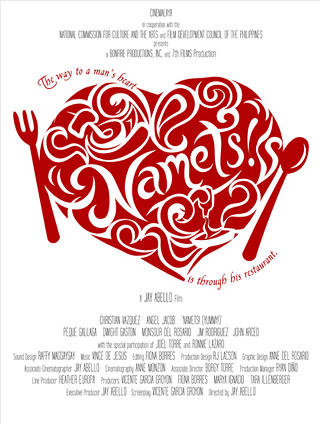
NAMETS - A HILIGAYNON LANGUAGE FILM IN CINEMALAYA


NAMETS


Follows the ongoing flirtation between Jacko and Cassie, two Negrense chefs who grew up in Bacolod, and whose lives revolve around food (correction - mine). Trouble starts when Jacko loses his Italian restaurant, Puccini's to a giant cockfighting debt. The moneylender Dolpo takes control of Puccini's and hires Cassie as a consultant for a total restaurant makeover. Cassie re-visions Puccini's into a place that serves traditional Negrosanon food, and we are treated to the full panorama of Negrosanon cuisine and the idiosyncrasies of Negrosanon eating. Along the way, Jacko and Cassie find time to finally fall in love and set aside their differences
.

source: imdb

show times
Tuesday, July 15 - 6:15 pm - Tanghalang Huseng Batute
Wednesday, July 16 - 9:00 pm - CCP Main Theater
Friday, July18 - 3:30 pm - MKP Hall
Friday, July18 - 6:15 pm - CCP Main Theater
Saturday, July 19 - 12:45 pm - MKP Hall


For Full Story

This is a Negrense film entry to the Cinemalaya Film Festival. Almost all the Hiligaynon-speaking actors that I know are here. IL PRIDE BABY!
Man, watching it made me hungry.

(In writing reviews, take note of the large number of people dismissing Hiligaynon as a dialect. We have a long way to go - our struggle is real.)

Saturday, July 19, 2008

CHALLENGING THE LAW


The National Anthem sounds even better sang in my language. I look forward to the day when this version of the National Anthem is sung in our schools without the fear of getting arrested for violating the law. Don't believe me please see chapter 2 section 36 of Republic Act 8491. The National Anthem should be sung in the National Language (whatever it means and it doesn't exist). (The law is very discriminatory! I can't believe my country has that and no legislators from other non-Tagalog ethno linguistic groups raised a howl over this.)

So, technically this girl is violating the Flag and Heraldic Code of the Philippines. Singing the national anthem in my native tongue is a crime in this "democratic country". Long before there was the Republic; the Hiligaynon-speaking people were already here. Screw the law! What will the national government do? Arrest these people? NO WAY. It will create UPHEAVAL AND STIR REGIONAL SENTIMENT if it does that.

Friday, July 18, 2008

HALLELUJAH! HALLELUJAH! HALLELUJAH! HALLELUJAH!

A great day for the RESISTANCE MOVEMENT: (wow hehe)

Philippine National Anthem in Bisaya

SHOOTING STRAIGHT By Valeriano Avila
Wednesday, July 16, 2008

A week ago today, the session at the Cebu City Council started as usual by singing the National Anthem in the Cebuano language or "Nasudnong Awit or Yutang Tabunon" despite the fact that there is a national law that penalizes anyone singing the national anthem in their own native tongues except in Filipino, which as we all know is a not-so-cleverly- disguised Tagalog. But after the National Anthem and the prayer in Cebuano, Presiding Officer Vice-Mayor Michael Rama suggested continuing the session using the Cebuano language in order to clarify all matters.

Thus it was a sort of unique, albeit historic day last week because Cebu City Councilors were speaking their own native tongue in their official session. That the City Council of Cebu defied that law against singing the National Anthem in another tongue other than Tagalog proves our point that that law has become inutile, especially when faced with our Constitutional realities where one of the most basic freedoms our people enjoy is the Freedom of Speech, which means the freedom to speak our native language.

How many times have we said it here before that we Filipinos are very good in making great laws, but we're the worst in implementing such laws? Year 2008 has been declared the International Year of Languages, which was proclaimed by the 61st General Plenary Assembly of the United Nations in their effort to promote "Unity in Diversity and Global Understanding. " This year, the UN is pursuing multilingualism as a means of promoting, protecting and preserving diversity of languages and cultures globally. I have been advocating our right to speak and be educated in our Cebuano language from the first day I became a columnist. Now something like this finally happens, almost like a dream come true!

The Philippines is also a signatory of this UN declaration, hence for a nation of more than a hundred spoken languages, we should be the first to understand the realities that we are a nation of diverse cultures and languages and that one of the most basic of human rights is the Right to Free Speech! Yet our educational policy is killing other Filipino languages.

We Cebuanos have long been proud of our cultural heritage and language; after all, the first people in this archipelago that the Europeans knew were Cebuanos. Oh yes, the Spaniards didn't forget Cebu, as this is where the leader of the Armada de Moluccas Ferdinand Magellan met his death in the hands of Chieftain Lapu-Lapu.

We are also known as the First Christians in this part of Asia. While we embraced Christianity, I would like to believe it was due to the Sto. NiÒo, the statue of the Holy Child Jesus that is so richly decorated and dressed up. Back then, Rajah Humabon and his Queen Juana had their Anitos small wooden idols, hence when Magellan presented them with the Sto. Nino, they immediately embraced it.

Back on our advocacy on language. I won't forget that 22 years ago when President Corazon "Tita" Cory Aquino issued a directive ordering all government offices that official communication in her administration was through the use of the Filipino language. The Province of Cebu then under Gov. Emilio "Lito" Osmena defied that Presidential Directive and filed a case in court to stop that Presidential directive and won.

I remembered Gov. Osmena asking the question, "What is really the Filipino Language, when the reality is, it is 99.9% taken from the Tagalog language?" Since that time, despite a law ordering the singing of the Philippine National Anthem in Filipino, the City of Cebu, the Cebu Provincial Board starts its sessions with the singing of the National Anthem in Cebuano. This includes the Rotary Club of Cebu (Mother). Let's hope that in today's session in the City Council, they would continue holding it in Cebuano, today and in the next sessions to come! Mabuhi ang Sugbuanon!

source

emphasis mine - Mr. Avila makes more sense and should be at the opinion page of the Philippine Star but his article is consigned at the back pages in the regional news section where most people don't even bother to read!

PEOPLE AND INSTITUTIONS HAPPY WITH THIS DEVELOPMENT

  1. NON-TAGALOG FILIPINOS (for inspiration 75% of the pop.)
  2. DIVERSITY LOVING TAGALOGS
  3. GROUPS SUCH AS DILA, SOLFED, DILFED AND OTHER PRO-DIVERSITY INSTITUTIONS
PEOPLE AND INSTITUTIONS UNHAPPY WITH THIS DEVELOPMENT
  1. TAGALISTA ELITE IN MANILA UNIVERSITIES
  2. INSTITUTE OF NATIONAL LANGUAGE (You're not? Prove it.)
  3. TBHON QUEZON and his wannabes
  4. RGMA -Bigtime Balita
  5. Some Television writers and directors


Friday, May 23, 2008

CONSTITUTIONAL DETECTIVE

I'm glad SOLFED has a website for I only get my language related articles from Defenders of the Indigenous Languages of the Archipelago (DILA) before. Now I have multiple sources. Yahoo!

Please read this very interesting article from Save Our Languages Through Federation (SOLFED) website.


The Lies of the 1934-1935 Constitutional Convention
Dr. Aurelio S. Agcaoili

The summer of 2007 in the Philippines was a date with history.

Like a detective, I did some exercise in disjunctive syllogism, the one that I taught in many convent schools, catholic colleges and seminaries, and in graduate school. Now I can announce: I did some sleuthing regarding the proceedings of the 1934-35 Constitutional Convention.

I pored over the records kept at the Lyceum Library, the National Library, the Supreme Court Library, and the Laurel Foundation Library.

I urged librarians to help me, giving them some clues to the problem I wanted to solve, pouring out my heart to that feeling that has something to do with how scholars did not do us justice by not telling us exactly what happened between the deliberations about the 'common national language provsion' of the 1935 Constitution by going back to the original documents of the proceedings. Even Andrew Gonzalez, with his Language and Nationalism, did not seem to have gone to the original records, judging from his discussion of the matter.

So what we have got is secondary information, some commentaries of commentaries of scholars commenting on the works of others. For instance, in his treatise on the 'evolution' of the Philippines national language, he simply reports, as follows: "The clamor for a national language as a symbol of solidarity and unity received official recognition during the 1934-1935 Constitutional Convention. The committee on official language presented a proposal which went through three drafts, in essence mandating the search for a common national language based on the existing Philippine languages. The committee on style, under Quezon's prodding, made a substantial alteration by stipulating that the common national language be based on one language rather than on many" (Language and Nationalism, 1980: 24).

Here we see that Gonzalez never bothered to look into the proceedings. The references listed at the end of his book did not mention anything about the Convention's proceedings; he relied, as is the case of his discussion, heavily on Aruego's 1936 account of the 1935 Constitution (The Framing of the Philippine Constitution, 1936).

I have grown weary of the language struggle so what I did was to revisit the records.

I first went to the National Archives and the National Library, two of the record-keepers of our memory as a people. Then I went to the Lyceum Library, to the Supreme Court, and lastly to the Laurel Foundation.

More than ten years ago, I had the good fortune of poring into the records kept in these government agencies when I was trying to understand the idea of the Philippine Revolution-or more appropriately, Philippine revolutions-from the point of view of the small man, the one who does not have the authority, the one whose desire was to love the homeland as a gentleman would love his woman. In short, I was interested with what scholars call today as "a history without authorities, " if by "authorities" we mean the big names, the big actors, those who played center stage roles in the drama we call the Philippine revolution/s. I had by this time grown suspicious of the self-conceit of heroes and their paid hacks. I had by this time begun to refuse to accept that idea that 'the revolution' was declared and finished by the Tagalog Republic.

By this time as well, I had read accounts of Ilokano katipuneros committing themselves to the cause of the revolution-in Ilokano, and with their own blood! Some of the surnames I could easily recognize including my own-surnames that were never mentioned in that 'national because nationalized'- and then eventually made 'natural' because already 'naturalized' , as is the case of Tagalog as P/Filipino-accounts, in a dogmatic form, of Zaide, Agoncillo, Guerrero, and Constantino.

You look into the history books fed to the minds of the young from the grades upwards and then in the university history courses, you have the same story, a grand and master narrative of some sorts, with the predictable names and the predictable incidents, minus the mulct and the dirt and the betrayal in the social drama that became a myth for the central and mainsream view of what Philippine history is all about. Never mind that in this grand and master narrative, the rest of the peoples of the Philippines, who had since the incursion of the invaders, been staging revolts, however unsuccesful these were from the point of view of the Tagalogistic notion of 'revolutionary success.'

This is the same tragic story we see in the story of the making of Tagalog as a national language and its being rammed into our throat until today by the monolingual Filipinos who know only Tagalog and who are reading the complexities and vast possibilities of the Philippines experience-and experience that necessarily tells us, to borrow Arnold Azurin's exitentialist and phenomenological phrase, that we are morally obliged to pursue our 'being and becoming.'

Here is what I found: That there was conspiracy, connivance, and collusion in the declaration of Tagalog as the basis of the national language.

As I write this, it is Thanksgiving in this land of our exile, and I have a lot to thank for-- such as this discovery of the triple cancer-the tripod of a C that continues to gnaw at our mind as a people, depriving us of that collective memory that should have been history's gift to us who try to keep on remembering.

But no, there are criminals of the Constitution, as the esteemed Vicente Albano Pacis declared for at least three times in his commentary on the national language situation, on the state of English language teaching in the country, and the ramming into our throat of the Tagalog language that, like the chameleon, continues to change color depending on the political, epistemic, and cultural ecology of the homeland.

First, the Gonzalez account of someone's account that there were three drafts that led to the 'framing' of the national language provision of the 1935 Constitution is lacking in perspective. The technical development of all the provisions of that constitution went through four 'drafts', with the fourth draft considered as the final draft and which was approved by the delegates of the convention, to wit, the title of that Fourth Draft as appended in the 1965 Proceedings of the 1934-1935 Constitutional Convention put together by Jose P. Laurel and published by Lyceum: "Appendix K-4: Final Draft of the Constitution of the Philippines, as approved by the Constitutional Convention on February 8, 1935."

Second, here is what is found in the Laurel Proceedings, which is not found in the version published by the House of Representatives: a first, second, third, and fourth draft of the Constitution.

Third, I must take note here that there are two accounts of the convention, one kept at the Supreme Court Library, and another that is put together by Laurel and is kept at the Laurel Foundation Library. The Supreme Court version, published by the House of Representatives between 1965 and 1966, does not contain the other drafts of the Constitution but only the final fourth draft and the proceedings beginning 1934 and ending in 1935.

Fourth, in terms of 'completeness' of the records therefore, the Laurel Proceedings contains a wealth of materials that reveals to us the kind of manipulation that happened during the convention. (I will continue to expose these manipulations by presenting documentary evidences and conjectures. )

It is not therefore true to say that the crowning of Tagalog as the glorified language of the land came as a logical choice of the people as represented by their delegates. This myth has to be unravelled for what it is: a myth that contains all the contradictions to our claims to linguistic justice and cultural democracy. In some of the accounts of Pacis, first at the Daily Express and then at the Inquirer, he recalled that right after the work of the convention was completed, many people who were in the know had been clamoring for the publication of the proceedings. This was an honorable way to check of the veracity of the proceedings and of the provisions of the 1935 Constitution.

That request was never granted.

The publication of the 1934-35 ConCon Proceedings happened only 30 years after when many of the delegates were long gone, senile, or had lapses in memory and judgment. Think of the kind of reaction and counter-reaction if these lies and manipulation were exposed as soon as the 1935 Constitution was approved.

The dishonesty of those involved was something.

The continuing linguistic injustice committed against the peoples of the Philippines at this time is an addendum to that dishonesty that became the basis for Tagalog as P/Filipino, that schizophrenic language of the center of power, commerce, education, and now media.

Think of academics schooled in this monolingual mindset, as is the case of many of the Tagalog teachers in the United States, many of them ignorant Ilokanos passing themselves off as Tagalog, or academics who cannot afford to have some intellectual breadth and depth-and resonance. One even had the temerity to say that we need to drumbeat Tagalog, a.k.a. P/Filipino as a 'global language' to, among others, avoid 'regionalism. ' In cases like this, we need to pray to the anitos and ask for patience so that these linguistic idiots will come to their senses.

Fifth, let these drafts from the Laurel Proceedings tell you of the ruses that happened.

First draft: Article XIII, Sec. 2: "A national language being necessary to strengthen the solidarity of the Nation, the National Assembly shall take steps looking to the development and adoption of a language common to all the people on the basis of the existing native languages."

Second draft: Article XIII, Sec. 2.a: "The National Assembly shall take steps toward the development and adoption of a common national language based on the existing native languages, and until otherwise provided by law, English and Spanish be the official languages."

Third draft: Nothing on Article XIII. Other parts of the draft of the Constitution had provisions. We must note here that the second draft was to be 'polished' for style-but not for substance! -by the Committee on Style chaired by Claro M. Recto. We note here that in the third draft, only those provision that have revisions for stylistic reasons were to be reviewed so that these provisions could be incorporated as part of the final, fourth draft. In the case of the provision on the national language, that was not mentioned, there was nothing, and thus, logically, the second draft is deemed that which was to move to the final, fourth draft.

But, here is what we have got:

Fourth draft: Article XIII, Sec. 3: "The National Assembly shall take steps toward the development and adoption of a common national language based on one of the existing native languages. Until otherwise provided by law, English and Spanish shall continue as official languages."

Now, we see a hand-or some hands.

The sleuthing continues.

FIGHTING BACK!!!

Language preservation warriors win on this one:


NCCA junks WIKA, Almario from language & translation committee

The National Commission on Culture and the Arts (NCCA) has disqualified Wika ng Kultura at Agham, Inc. (WIKA) headed by Virgilio S. Almario from the coveted National Committee on Language and Translation (NCLT).

It can be recalled that Komisyon ng Wikang Filipino (KWF) Chairman Dr. Ricardo Ma. D. Nolasco filed a petition to declare as null and void the NCLT elections, citing grounds of (1) failure to communicate with stakeholders, and (2) gross under-representation of the sector and mass disenfranchisement.

Non governmental organization Save Our Languages Through Federalism Foundation Inc. through its representative for the National Capital Region (NCR) Santiago B. Villafania has intervened supporting Nolasco's petition and "adopted the arguments of the KWF calling for a failure and/or nullification of election for non-fulfillment of membership qualifications and for not being registered with SEC for one and a half years."

"There is gross misrepresentation of the ethno-linguistic peoples of the Philippines in the NCLT committee as is clear from the KWF protest letter that lists the interlocking directorates of Tagalog writers that control the committee. In particular, the non- Tagalog Peoples of the Philippines have been left without a valid voice. This gross misrepresentation of our peoples could be regarded as an outright violation of the United Nations declarations on Human Rights, in particular linguistic rights, to which the Philippine Government is signatory to. In brief, the Philippine Government has an obligation to adequately represent all its ethno-linguistic peoples in its governmental bodies such as the NCCA," Dr. Jose Ma. Eduardo Dacudao, SOLFED president said.

Source

Monday, May 5, 2008

THE SOLUTION II

Is the situation that bleak? Is it really going to happen? It will, if we don’t act now and publicize the issue. The more people aware of the dying Philippine languages situation the more people will get involved. It is the awareness of the issue that could be the first step of saving our other languages – it was when I learned of this condition that I got involved. Everyone esp. those of the “minority” tongues should get involved.
It’s good to note several politicians are conscious of this and are acting fast though I prefer short term and feasible solution first at the moment. Federalization is a long process and I’m not sure whether it would happen (change in the system of government) soon. But it is the best solution.


Ethno-linguistic minorities
in a federal government

By Prof. Fred Cabuang

IN a surprising move, Sen. Aquilino Pimentel and other senators recently sponsored a multi-party resolution for the federalization of the Philippines. It proposes the creation of states that will establish 11 centers of finance and development in the archipelago.

These states are Northern Luzon, Central Luzon, Southern Tagalog, Bicol, Minparom (Mindoro Oriental, Mindoro Occidental, Palawan, Romblon and Marinduque), Eastern Visayas, Central Visayas, Western Visayas, Northern Mindanao, Southern Mindanao and BangsaMoro (Lanao del Sur, Maguindanao, (Shariff Kabunsuan) Basilan, Sulu, and Tawi-Tawi).

WE ARE A DYING PEOPLE II

Some people with hidden agenda won't believe this but this is a fact: Non-Tagalog Philippine languages are dying. Need more proof? Hah! Just in time!

Even Kapampangan and Pangasinan are now

DYING LANGUAGES

By Rene Q. Bas

Experts expect Kapampangan and the Pangasinan language—out of the 10 major Philippine languages—to be extinct 20 years from now.

How can this happen? It’s easy to visualize how our Negrito (or Agta or Aeta or Ata) fellow Filipinos can disappear completely from the scene. (See “Negrito (Agta) languages’ descent to extinction” below by Prof. Fred S. Cabuang.) They die and their languages go with them forever.

Experts give different figures about the number of our languages. Most say there are 120 living languages and 175 in all including our extinct languages.

The eight major languages, according to number of speakers, and their percentage of the total Philippine population are: Tagalog 29 percent, Cebuano Bisayan 21.17 percent, Ilocano 9.31 percent, Hiligaynon Bisayan 9.11 percent, Bicolano 5.69 percent, Waray Bisayan 3.81 percent, Kapampangan 2.9 percent and Pangasinan 1.01 percent.

Language experts are agreed that languages spoken by less than 300,000 persons are endangered. They can become extinct soon enough. They see that within 20 years both Kapam-pangan and Pangasinan will no longer be spoken by a native speaker.

That the other non-Tagalog languages could also someday be in peril is indicated by the steady decline of their native speakers as a part of the population. In the past 20 years, Cebuano speakers have been reduced to just about one-fifth of the Filipino people. They were one-fourth less than 10 years ago. Ilocanos were 12 percent of the population in 1948. They now make up only 9 percent of the population. The Ilonggos show the same decline…

Source


Institutionalized genocide is another term to describe it.


Related links:

The Solution
Yeah RIGHT
Dying People

Tuesday, March 4, 2008

The Solution

We don't have to rely on our inept government to save our beloved language as it is biased in favor of Tagalog. But I'm glad President Arroyo understood the importance of English when she reinstated it as the medium of instruction in public schools.

Another language related news:


Well, it may come as a surprise to many that a lot more people are now batting for saving our native languages. Not just the Save our Language through Federalism. And they are the ones who are also batting for constitutional change and the adoption of the federal system.

Well, for one, I got a Yahoo mail from Manny (Mon Ramirez), which stated that "We, the non-Tagalogs, majority of the people of the Philippines have our own district mother tongues, our own district languages. We have no commonality with Tagalog."

Manny adds - Tagalog is not even prescribed as the national language in the 1987 Constitution. Instead, Section 7, Art. XIV states that the official language is Filipino as it shall be developed taking into account then other languages of the Philippines …

To impose Tagalog on the non-Tagalog peoples is not acceptable. It is divisive, not unifying, Manny added.

Solfed's Khalid points out that the problem comes after Dr. Jose Rizal, when the emergence of Tagalistas and their witting or unwitting form of cultural domination. It was wrong to speak another Philippine language in the classroom (1960-90s).

"Fortunately, there are people here in the Philippines, organizations like Solfed and Dila (to mention just a few) who made us aware of a Tagalog dominant culture to the detriment of the other regional cultures."

"There is even now an interpretation that the Katipuneros were only interested in a Tagalog Republic. Araneta, Lacson, et all, here in Negros Island, did not necessarily communicate and align themselves with Aguinaldo when they (Araneta and Lacson) took over the Spanish garrison here in Bacolod," Philip pointed out.

Source

We won't die out that easily. Here are more excerpts:

In various parts of the country, there has been a growing movement to save our native language. The point - when you destroy the ethnolinguistic tongue of the people, you destroy their soul, i.e. their culture disappears, so with their history.

That is why, in the Caraga Region, Dr. Dacudao reported, disc jockeys of radio stations, have started to use Butuanon and Cebuano in their commentaries and their programs.

And, yes, they also had the National Anthem translated into Butuanon. And the dwindling number of Butuan residents and natives speaking their mother tongue, have considerably risen.

"And, the more notable result - we are communicating with one another more effective," Dr. Dacudao pointed out. And, yes, he is aided by Taylor Calo who had recently helped organize the Antique SOLFED that is reviving interest in the Kinaray-a. That had touched Antique Governor Sally Zaldivar-Perez, also Regional Development Council chair, who recently astonished a lot of people when she and Rep. Janette Garin (1st District, Iloilo) paid tribute to their native tongue by using it in their public speeches during an RDC meet.


Source

I think it would help if the government allows teaching of Bisaya in Bisaya-speaking areas, Hiligaynon in Ilonggo areas, etc.,etc.

Yeah Right!

Are other Philippine languages really dying? Some people will of course doubt it either from ignorance or arrogance. However I have more news clips:

“One, there is a dearth of literature and official use of the provincial Philippine languages. Many of these languages do not even have a written literature, and are not used in government and schools in their own territories. Residents can hardly read and write in their own language. New songs, movies, TV shows, essays, poems and books are not being composed in the provincial languages, and the few that are being made, because of the minority status attached to them by state policy, are not being patronized by their own speakers.”

“Two, National Statistics Office surveys show that every Philippine ethnolinguisitic people is decreasing in percentage of the Philippine population, except the one that speaks ‘Filipino’ as its native tongue. When the natural birth rate of these people finally approaches zero, as is the trend at present, their absolute numbers will also decrease, eventually to extinction if we do nothing now.

“Three, minority people are losing territory fast to the center’s ethnolinguistic group. For example, Puerto Princesa in Palawan, which used to speak Cuyonon, no longer does, and the Cuyonons [a Western Visayan people] are becoming confined to a small group of islands off Palawan and will inevitably die out should we do nothing. Same story for the rest of the native Palawan, Mindoro and Zam-bales languages.

Likewise, the rich array of native languages of Romblon (including Romblomanon, Unhan, Asi, Odiongon) are dying out. Transplanted Tagalog is fast replacing the indigenous tongues of Davao and Cotabato. Even traditionally big and influential ethno-linguistic people such as the Kapampangans of Pampanga and the Bicolanos of Camarines Norte are in the process of getting wiped out.”

SOURCE

The Philippine government has a great habit of NOT listening to peaceful advocacies like this. It prefers someone to bomb something in order to get its attention and support for example the rebels in the south and bandits-cum rebels.....Please hear us out! I do hope peaceful advocates of change should be heard.

We are a Dying People

It is time to defy Surian ng Wikang Pambansa and tell it to their faces that we, the non-Tagalog people will survive. Extinction and marginalization of other Philippine languages is not the future I want to bequeath to my children. Now is the time to act:

RP’s ethnic languages dying, Pimentel warns

MANILA, Philippines -- Except for Tagalog, which has been mandated by law and the Constitution as basis of the country’s national language, the country’s other ethnic languages are dying, Senate Minority Leader Aquilino Pimentel Jr. said.

In a privilege speech earlier this week, Pimentel called on the government to save these ethnic languages from extinction by allowing them to be used as a medium of instruction in elementary schools in the respective regions where they are widely spoken.

“Now is the time to make the first move to revise the curriculum of our educational system so that we can allow the use of the local languages as the medium of instruction in our grade schools. Our other major languages are dying. We have to save them now,” he said.

The senator cited data showing that Tagalog users have steadily increased in number from 19 percent of the population in 1948 to 29.30 percent in 1995.

In contrast, users of other ethnic languages are declining from the same period: Cebuano from 25 percent to 21.17 percent; Iloko, from 12 percent to 9.31 percent; Hiligaynon from 12 percent to 9.11 percent; Bicol from 8 percent to 5.69 percent; Waray from 6 percent to 3.81 percent; Kapampangan from 3 percent to 2.90 percent; and Pangalatok from 3 percent to 1 percent....